KentuckyKen
Well-Known Member
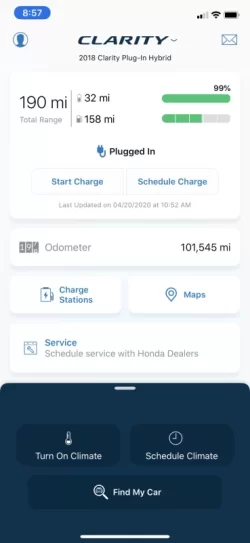
The only way I know is to get the dealer to hook it up to their i-HDS and run that Battery Capacity Signal and compare that to the nominal 55 Ah when new. @AnthonyW may be able to pull that with the PIDs he is working with ScanGauge.The more important issue is battery degradation, which directly affects range. Does anyone know a good way to determine that without taking it back to the dealer? I mostly do around town driving, charging to 80% after each run to minimize depth of discharge which is one of the factors that affect battery degradation. After 1.7 years of ownership and about 12,000 EV only miles (the rest being HV), one of my regular 14 mile loops still only use 17% under optimal conditions (75 degrees outside with no A/C turned on). At 70 degrees I use 18%, or more at all other temps (varying due to the extent of A/C or heating). That hasn't changed since I bought the car so I'm not seeing any battery degradation. Of course, the BMU could be fooling me by decreasing the buffers in order to maintain the range. That would be really bad because that would then accelerate battery degradation if Honda did that. I still get 8%/per hour during charging using the 120v charger, the same as when the car was new so hopefully all is well.
I applaud your efforts to reduce the depth of discharge, but suggest you periodically do a full charge (at 1x per month) since the common assumption is that the BMS performs cell balancing at the end of a full charge. We are not 100% sure on that, but it is logical and jibes with Honda’s recommendation to fully charge each time prior to driving.
My ChargePoint EVSE doesn’t have the capability to charge to a given %SOC and I’m too lazy to try calculating and setting the length of charging every time. So all I do is skip charging if I have enough SOC for the next day’s driving and I set the timer to charge early in the morning so the battery doesn’t sit as long fully charged. And I think garaging helps reduce temperature extremes. I also try to avoid extreme or rapid discharge of the battery by avoiding extreme acceleration and using preconditioning in the winter. Edited: I also reduce depth of discharge by rarely going below 20-30% allowable SOC (in addition to the buffer) since almost all my driving is local and under 40 miles/day.
As I understand it, temperature extremes, rapid discharge, over charging, time spent at 100% charge, and complete discharge are the factors that affect Li-ion battery health. {Edited: and of course there is a finite # of charge cycles} (Have I left any out?) Fortunately, our BMS has buffers at top and bottom of the SOC and we have good liquid cooling. So the question is really do we gain anything significant by “babying” the battery?
Let’s all meet back in 8 years and see if any of this “being kind to your battery” made an appreciable difference. Of course by then it will be too late. So I’m resigned to being as nice to my battery as I can without obsessing about it or inconveniencing myself.
Last edited: