They’re taken from a Caterpillar report on motorhome fuel economy. The document included data for a 4250lb automobile. Below are a couple of screenshots from the document.I'm very curious how you calculated these figures. You using a drag coefficient calculator?

You are using an out of date browser. It may not display this or other websites correctly.
You should upgrade or use an alternative browser.
You should upgrade or use an alternative browser.
My terrible morning with the Clarity
- Thread starter Geor99
- Start date
- Replies 112
- Views 1K
Here is some similar behavior and some interesting back and forth on this other Clarity forum on this exact topic:
EV Battery Completely Depleted
EV Battery Completely Depleted
Here is a great video about the Clarity engine and how it works from that other Clarity forum:Here is some similar behavior and some interesting back and forth on this other Clarity forum on this exact topic:
EV Battery Completely Depleted
The Clarity PHEV does not contain a CVT.
Honda Corporation used marketing doublespeak, in its naming of its "e-CVT" transaxle. This system is used in several Honda product lines, in addition to the Clarity PHEV.
If you'd like to see what's "under the hood", you can do no better that Professor Kelly's videos from Weber State University's automotive tech program:
Attachments


I'm not a fan of the droning engine sounds in CVT-equipped vehicles (like my 2010 Insight) and was happy to learn in 2016 the upcoming Clarity wouldn't have one. To my disappointment, when the Clarity's engine is running, it sounds like it's hooked to an actual CVT. Because it sounds and acts like an actual CVT, the e-CVT moniker is quite appropriate. Other than the sound in HV, I find driving the Clarity enjoyable, but it's much more enjoyable when the engine is off.
I agree with you. I have read about how the engine works; but watching that video really drove home to me how everything works. If you have interest in motors or in the Clarity motor in particular, I STRONGLY recommend taking the 20 minutes or so to watch that video.I'm not a fan of the droning engine sounds in CVT-equipped vehicles (like my 2010 Insight) and was happy to learn in 2016 the upcoming Clarity wouldn't have one. To my disappointment, when the Clarity's engine is running, it sounds like it's hooked to an actual CVT. Because it sounds and acts like an actual CVT, the e-CVT moniker is quite appropriate. Other than the sound in HV, I find driving the Clarity enjoyable, but it's much more enjoyable when the engine is off.
He does a really good job of explaining everything as he assembles the gears, the 135 kw electric motor, power generator (106kw), flywheel, and drive shafts very clearly in the video. He even shows how the parking brake engages with one of the gears preventing it from rotating which prevents the car from moving.
I was surprised to see 2 oil pumps. Man, those look like a bear to replace; so hopefully that wont be needed
 I also learned how the oil is in use all of the time, even in ev mode; and how the gas engine only mode kicks in when the oil pressure is high. (It is possible that I am confusing oil with transmission fluid here.) He said that it only kicks in when the speed is above 62mph, the non-battery powered mode which the professor calls "Engine- Only" mode. This is different than using the gas engine to power the generator to charge the battery to propel the car via the electric motor.
He said that there are 3 modes:
EV Mode- batteries powering the 135 kw electric motor,
Series Hybrid Mode- Gas engine charging the battery via the 106kw generator to power the 135 kw electric motor, which makes it a Series Hybrid, remember that the gas engine does not power the car directly in this mode;
and
Engine-Only Mode-Above 62 mph where the gas engine turns the gears directly to power the car, which can be in use in tandem with the other modes. He said that at speeds above 62 mph, the gas engine is more efficient than the electric one.
I am sure that I will be corrected, if I misunderstood any of this

Last edited:
I believe the Clarity PHEV's Engine Drive Mode can kick in as slow as 45 mph. It must be quite efficient or Honda wouldn't have added the expensive and weighty clutch, gears, and housing (along with expensive, but unweighty software) to make it possible. The Chevy Volt plug-in hybrid had a similar mode, but, unlike Honda, GM tried to downplay its existence.and above 62 mph where the gas engine turns the gears directly to power the car
Robert_Alabama
Well-Known Member
If I did the math right based on the numbers quoted in the video (2.757 overall ratio for gasoline engine RPM to tires RPM and with 235/45/18 tires being 766 rev/mile), I get the following for the Engine Drive Mode:I believe the Clarity PHEV's Engine Drive Mode can kick in as slow as 45 mph.
Engine RPM Speed
1600 RPM - 45.46 mph
2000 RPM - 56.82 mph
2400 RPM - 68.19 mph
2800 RPM - 79.55 mph
3000 RPM - 85.23 mph
Most engines hit their optimum fuel efficiency at about 2000 rpm. The Clarity has excellent fuel economy between 55 and 60 mph. I know some of that is that wind resistance increases with the square of speed, but this also seems to be the sweet spot designed for the engine efficiency.
And please excuse me if this has been covered before... I am old with too short a memory...
Last edited:
Little clarification.He said that there are 3 modes:
EV Mode- batteries powering the 135 kw electric motor,
Series Hybrid Mode- Gas engine charging the battery via the 106kw generator to power the 135 kw electric motor, which makes it a Series Hybrid, remember that the gas engine does not power the car directly in this mode;
and
Engine-Only Mode-Above 62 mph where the gas engine turns the gears directly to power the car, which can be in use in tandem with the other modes. He said that at speeds above 62 mph, the gas engine is more efficient than the electric one.
I am sure that I will be corrected, if I misunderstood any of this
EV Mode: Drive tires are driven by the High Voltage Traction battery and Electric motor ONLY
HV Mode: The Traction battery drives the electric motor, and the ICE engine supplements extra energy to maintain the SOC of the Traction battery when HV mode was turned on. Only when speeds are above say, 60mph and steady speed, does the ICE engine engage the clutch and directly connects to the wheels.
There is NO engine only mode. Even when the engine is connected to the drive wheels, some of the power is still coming from the traction battery. It switches from 100% ICE power and Battery power. It's never steady. (I could be wrong and don't mind being corrected).
A good exercise is to go to the Power screen and see how power is delivered to and from the traction battery, and how quickly the ICE uncouples from the wheels when you give it just a little gas to accelerate at speed.
I have seen the car run purely from the engine and not drawing any battery whatsoever, according to the monitor in the car. It is rare, but I have definitely seen it. Also, little gears appear on the screen that you can see through the steering wheel when this happens.
Once again, this is rare but I have seen it run in engine only mode on occasions.
Page 132 in owners manual shows this:
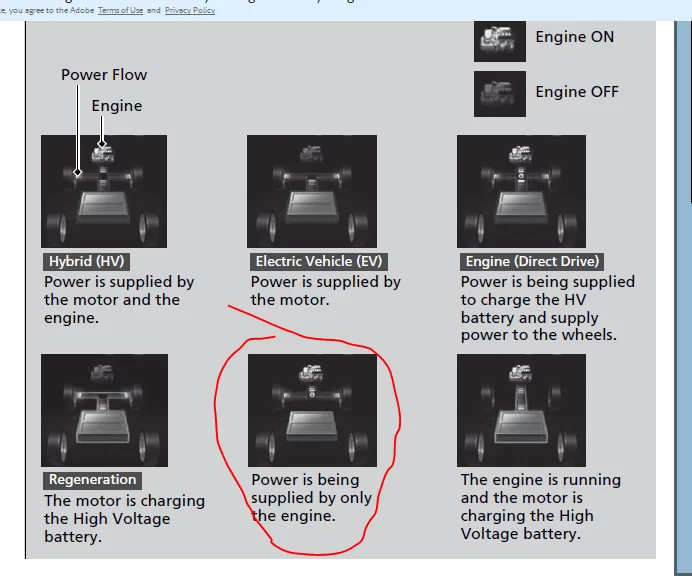
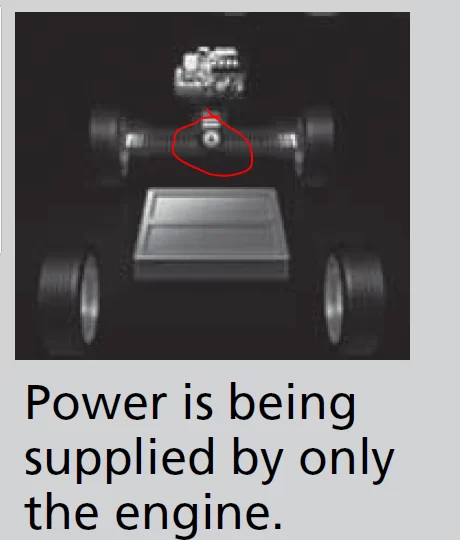
Here is a zoomed in image showing the turning gears that only appear when the motor directly powers the car. It appears in 2 of the 6 images above- middle bottom row and far right on top row.
Once again, this is rare but I have seen it run in engine only mode on occasions.
Page 132 in owners manual shows this:
Here is a zoomed in image showing the turning gears that only appear when the motor directly powers the car. It appears in 2 of the 6 images above- middle bottom row and far right on top row.
Last edited:
You are right. Good catch. I have seen that but only for very brief moments.
I guess what I meant is, you can't set it to an Engine only "Mode". It toggles back and forth from charge, regen, and sometimes runs engine only then sometimes engine+charge (Driect drive) at the same time. I see that a lot.
I guess what I meant is, you can't set it to an Engine only "Mode". It toggles back and forth from charge, regen, and sometimes runs engine only then sometimes engine+charge (Driect drive) at the same time. I see that a lot.
I guess what I meant is, you can't set it to an Engine only "Mode". It toggles back and forth from charge, regen, and sometimes runs engine only then sometimes engine+charge (Driect drive) at the same time. I see that a lot.
Interestingly, EV Mode can be selected. However, aggressive acceleration will result in the engine running, so there isn’t a dedicated EV Mode even though a button exists to set it to EV Mode.
Similarly, Engine Drive Mode will engage based on conditions and driver input. By the way, EDM can and will engage at 45-46mph. Honda defines and describes EDM, so anyone who’s read that information knows this. Let’s end the confusion about the speed at which it can engage. It isn’t 62mph. I’ve operated the Clarity in EDM up to 85mph.
To my disappointment, when the Clarity's engine is running, it sounds like it's hooked to an actual CVT. Because it sounds and acts like an actual CVT, the e-CVT moniker is quite appropriate.
It sounds like a variable speed or inverter generator, which is exactly what it is when it isn’t in EDM. It’s actually somewhat different than many CVT’s because it doesn’t produce the sensation of gear shifts that are engineered into CVT’s to simulate the feel of an automatic transmission. CVT’s have a mechanical/belt driven connection to the wheels and RPM’s are software controlled to maximize efficiency. The engine/generator in the Clarity will rev to whatever speed is necessary to produce the appropriate amount of electricity. This creates a noticeable disconnect between throttle input, engine speed and acceleration that has caused alarm for some owners. Granted, it is a much less desirable experience than a CVT, which is a pretty low bar.
One of my biggest gripes with the Clarity. Why have a mode selector if its easily overridden. SMH.Interestingly, EV Mode can be selected. However, aggressive acceleration will result in the engine running, so there isn’t a dedicated EV Mode even though a button exists to set it to EV Mode.
Also, The soft stop on the gas pedal. What's the point of that. I would think that's the soft stop (which is 75% throttle) to stay EV then it clicks to 100% and clicks the ICE on.
One of my biggest gripes with the Clarity. Why have a mode selector if its easily overridden. SMH.
Also, The soft stop on the gas pedal. What's the point of that. I would think that's the soft stop (which is 75% throttle) to stay EV then it clicks to 100% and clicks the ICE on.
Because someone else would complain if it wasn’t easily overridden. Truly restricting the car to an EV only mode would limit power to 121hp. When more power is called for the engine has to join the festivities.
Imagine if you had to manually disengage Adaptive Cruise Control in order to accelerate to pass another vehicle. The same situation could arise if the EV limited power couldn’t get you past grandpa's camper in time to avoid a head on collision with a big rig.
Isnt the Electric motor 181hp? and in Combination with the ICE, total output is 212HP?Truly restricting the car to an EV only mode would limit power to 121hp.
I only said 62 because that is what that professor in that video said. He could very easily be wrong about that speed; although he did seem knowledgable about the engine in general.Interestingly, EV Mode can be selected. However, aggressive acceleration will result in the engine running, so there isn’t a dedicated EV Mode even though a button exists to set it to EV Mode.
Similarly, Engine Drive Mode will engage based on conditions and driver input. By the way, EDM can and will engage at 45-46mph. Honda defines and describes EDM, so anyone who’s read that information knows this. Let’s end the confusion about the speed at which it can engage. It isn’t 62mph. I’ve operated the Clarity in EDM up to 85mph.
Last edited:
Isnt the Electric motor 181hp? and in Combination with the ICE, total output is 212HP?
The electric motor is rated at 181hp. The batteries can provide enough current to produce 121hp. The engine, when running as a generator, can provide enough current to produce 60hp. That’s how the motor provides 181hp.
I only said 62 because that is what that professor in that video said. He could very easily be wrong about that speed; although he did seem knowledgable about the engine in general.
Yes, the professor is wrong. Perhaps he misspoke. I haven’t watched the video but based on your description, it sounds like he elaborated on why EDM or Direct Drive engages at 62mph. If so, he is misinformed.
He may be knowledgeable, but his statement on when EDM may engage is incorrect.
My math is not mathing. The car is rated at 212HP not 181HP.The electric motor is rated at 181hp. The batteries can provide enough current to produce 121hp. The engine, when running as a generator, can provide enough current to produce 60hp. That’s how the motor provides 181hp.
Maybe full EV mode: 181hp Electric Motor alone.
Hybrid (ICE acts like generator): 212HP (31HP from the "generator." Hence why when you completely deplete the battery, the ICE screams and goes into limp mode since only 30ish HP is available from the ICE)
I don't know. Just thinking about the total output.
Car and Criver
"The motor produces 181 horsepower and 232 pound-feet of torque and pulls juice from a 17.0-kWh lithium-ion battery pack. In addition to charging the battery, the gas engine can also assist in directly driving the wheels, bringing the car’s total horsepower to 212."
Honda website
| Displacement - 1498 cc |
| Horsepower (SAE net) - 103 @ 5500 rpm |
| Horsepower - 181 @ 5000-6000 rpm |
| Torque - 232 lb-ft @ 0-2000 rpm |
| Total System Horsepower - 212 |
Last edited:
Maybe full EV mode: 181hp Electric Motor alone.
Hybrid (ICE acts like generator): 212HP (31HP from the "generator." Hence why when you completely deplete the battery, the ICE screams and goes into limp mode since only 30ish HP is available from the ICE)
I don't know.
Why speculate when you can know?
I can only suggest that you invest some time to research what Honda has said about how the Clarity operates. I no longer have their document about the development of the powertrain in my files, but that would be a good start.
As for the Car and Driver Statement, it is one of several that were made by motor journalists that did not accurately describe how the vehicle works. There was a great deal of misunderstanding about the car when it was initially released and some of that confusion continues today.
To be clear, I’m only trying to help you understand how the electric motor outputs 181hp. Hondas claim of total system hp of 212, is still open for debate. There was a reasonable explanation provided elsewhere on this forum that the actual 181hp output of the electric motor is equivalent to a 212hp conventional vehicle with a calculated 15% loss from the crankshaft to wheels. Regardless, the proposed theory from C&D is preposterous because the condition will never exist that allows EDM/Direct Drive to remain engaged when maximum power is called for.