
From Clarity to Genesis Electrified G80

I purchased my 2019 Honda Clarity new in early 2021, and after the federal tax credit, it was an incredible value.

Over the next 5 years, I put 79,000 miles on it and, aside from tires, oil changes, and replacing the 12V battery, it needed nothing. The car was truly phenomenal.

I kept a detailed fuel log the entire time, and my average across those 79,000 miles was 94.1 MPG. Even more impressive, I noticed essentially no battery degradation—the car was still giving me about 47 miles of EV range at the end of my ownership.

When I traded it in for my next car, I had only lost about $5,200 in depreciation over those 5 years (when calculated including the $7,500 federal tax credit I received in 2021). Honestly, the Clarity was the best car I had owned up to that point.

What pushed me to upgrade was realizing that I enjoyed the Clarity most when it was running in EV mode. After 5 years with a PHEV, I knew I was ready to go fully electric.

Large-battery PHEVs like the Clarity have a real advantage: around town, they function like an EV, while still giving you the flexibility of gas for road trips. For people who don’t want to plan charging stops, that’s a huge benefit.

When the federal EV credit expired in September 2025, EV demand dropped sharply, and I took the opportunity to buy another niche/orphan car: the Genesis Electrified G80. Orphan models depreciate faster because their niche appeal limits demand. It does not mean they are bad cars; Clarity is a perfect example.

While I was very happy with the Clarity, the Genesis is a major upgrade in every way. The biggest improvements for me are the size (I’m no longer hitting my leg on the center console), better suspension, much better sound deadening, a significantly better sound system, far more power, a larger CarPlay screen with a physical control knob, better driver assist features, and cooled seats—which matter a lot in Arizona.

The Genesis is in a different class, so the comparison may not be entirely fair. But because of its own orphan-model status, it ended up being just as good of a deal as the Clarity was in 2021—except for a significantly better car.

Honestly, I don’t miss the Clarity at all. It served its purpose perfectly. Just like the Clarity was a huge upgrade over my 2014 Toyota Prius in 2021, the Genesis feels like the same kind of leap forward compared to the Clarity in 2025.
 

Attachments
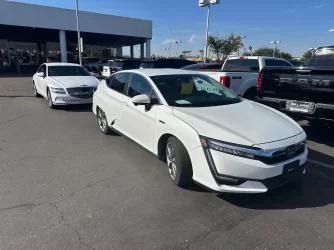
  • IMG_5824.webp
    IMG_5824.webp
    568.1 KB · Views: 18
Last edited:
I purchased my 2019 Honda Clarity new in early 2021, and after the federal tax credit, it was an incredible value.

Over the next 5 years, I put 79,000 miles on it and, aside from tires, oil changes, and replacing the 12V battery, it needed nothing. The car was truly phenomenal.

I kept a detailed fuel log the entire time, and my average across those 79,000 miles was 94.1 MPG. Even more impressive, I noticed essentially no battery degradation—the car was still giving me about 47 miles of EV range at the end of my ownership.

When I traded it in for my next car, I had only lost about $5,200 in depreciation over those 5 years (when calculated including the $7,500 federal tax credit I received in 2021). Honestly, the Clarity was the best car I had owned up to that point.

What pushed me to upgrade was realizing that I enjoyed the Clarity most when it was running in EV mode. After 5 years with a PHEV, I knew I was ready to go fully electric.

Large-battery PHEVs like the Clarity have a real advantage: around town, they function like an EV, while still giving you the flexibility of gas for road trips. For people who don’t want to plan charging stops, that’s a huge benefit.

When the federal EV credit expired in September 2025, EV demand dropped sharply, and I took the opportunity to buy another niche/orphan car: the Genesis Electrified G80. Orphan models depreciate faster because their niche appeal limits demand. It does not mean they are bad cars; Clarity is a perfect example.

While I was very happy with the Clarity, the Genesis is a major upgrade in every way. The biggest improvements for me are the size (I’m no longer hitting my leg on the center console), better suspension, much better sound deadening, a significantly better sound system, far more power, a larger CarPlay screen with a physical control knob, better driver assist features, and cooled seats—which matter a lot in Arizona.

The Genesis is in a different class, so the comparison may not be entirely fair. But because of its own orphan-model status, it ended up being just as good of a deal as the Clarity was in 2021—except for a significantly better car.

Honestly, I don’t miss the Clarity at all. It served its purpose perfectly. Just like the Clarity was a huge upgrade over my 2014 Toyota Prius in 2021, the Genesis feels like the same kind of leap forward compared to the Clarity in 2025.
I too am an owner of a Clarity (2018 model year), and although our path has not been quite as smooth as yours, having to replace the air conditioning components under warranty, and then an AC component that was not covered under warranty. Overall, the car has been wonderful and we're keeping it.

I just bought a smaller Korean cousin of sorts, a 2023 Kia Niro Wave Electric, low miles, still under warranty. That car, even though it's smaller, with a shorter wheelbase, rides more comfortably than the Clarity. And like your experience, it and the Clarity were significant upgrades to any other cars I've driven prior to it. Love the ventilated seats and smart tech in the Niro.

It's nice accelerating quietly without the Clarity quirk of the angry bees ;-)
 
Yes, Korean cars have become really impressive, especially with how strong their EV lineup is now.

For people who have been thinking about upgrading from a Honda Clarity to a full EV, there are some excellent deals available. A slightly used Hyundai Ioniq 6 SE RWD with 361 miles of range can be found in the mid to low $20k range, which is a fantastic value. Your Kia Niro EV is another great example of a well-priced, practical EV.

I probably could have driven my Clarity another 70,000 miles without much trouble—it was that reliable. But the EV market has evolved rapidly, and there are now a lot of affordable, genuinely excellent options available. For most use cases, a full EV is simply a better proposition than a PHEV.

Whoever bought my old Clarity for $18k from the dealer got a very good car. But for just $6k–$7k more, there are newer, significantly better full EVs on the market, which makes the upgrade much easier to justify.
 
I purchased my 2019 Honda Clarity new in early 2021, and after the federal tax credit, it was an incredible value.

Over the next 5 years, I put 79,000 miles on it and, aside from tires, oil changes, and replacing the 12V battery, it needed nothing. The car was truly phenomenal.

I kept a detailed fuel log the entire time, and my average across those 79,000 miles was 94.1 MPG. Even more impressive, I noticed essentially no battery degradation—the car was still giving me about 47 miles of EV range at the end of my ownership.

When I traded it in for my next car, I had only lost about $5,200 in depreciation over those 5 years (when calculated including the $7,500 federal tax credit I received in 2021). Honestly, the Clarity was the best car I had owned up to that point.

What pushed me to upgrade was realizing that I enjoyed the Clarity most when it was running in EV mode. After 5 years with a PHEV, I knew I was ready to go fully electric.

Large-battery PHEVs like the Clarity have a real advantage: around town, they function like an EV, while still giving you the flexibility of gas for road trips. For people who don’t want to plan charging stops, that’s a huge benefit.

When the federal EV credit expired in September 2025, EV demand dropped sharply, and I took the opportunity to buy another niche/orphan car: the Genesis Electrified G80. Orphan models depreciate faster because their niche appeal limits demand. It does not mean they are bad cars; Clarity is a perfect example.

While I was very happy with the Clarity, the Genesis is a major upgrade in every way. The biggest improvements for me are the size (I’m no longer hitting my leg on the center console), better suspension, much better sound deadening, a significantly better sound system, far more power, a larger CarPlay screen with a physical control knob, better driver assist features, and cooled seats—which matter a lot in Arizona.

The Genesis is in a different class, so the comparison may not be entirely fair. But because of its own orphan-model status, it ended up being just as good of a deal as the Clarity was in 2021—except for a significantly better car.

Honestly, I don’t miss the Clarity at all. It served its purpose perfectly. Just like the Clarity was a huge upgrade over my 2014 Toyota Prius in 2021, the Genesis feels like the same kind of leap forward compared to the Clarity in 2025.
I've been considering a similar move. Bro happy with my 2018 Clarity PHEV but would like more EV range and power going over the mountains. And also a real volume knob!
 
I've been considering a similar move. Bro happy with my 2018 Clarity PHEV but would like more EV range and power going over the mountains. And also a real volume knob!
Yes, having EV power in the mountains is a huge advantage.

We go to Flagstaff often, and that drive involves about 6,000 feet of elevation gain. In the Honda Clarity, I had to be very strategic with EV mode to minimize the “angry bees” moments when the gas engine would kick in loudly under load. I could reduce it, but I could never eliminate it completely.

For a while, optimizing EV mode vs. gas engine use was kind of fun, but realistically, it wasn’t very practical. With a full EV, driving up the mountains feels effortless.

I drive the Genesis Electrified G80 mostly in ECO mode, which significantly reduces power and acceleration (it even switches the car to RWD), and it still feels much stronger than the Clarity did even in Sport mode.

What has surprised me most is efficiency—I’ve averaged 3.8 mi/kWh over the last 6,000 miles. That’s impressive for an AWD car with 365 hp and over 5,000 lbs of weight. The Clarity was definitely efficient, and technically more efficient than the Genesis, but the Genesis is remarkably efficient considering how much more substantial of a car it is.

Another thing people don’t always think about when upgrading is how much better modern ADAS features have become. The driver assistance and safety systems in newer cars are significantly better than what was available when the Clarity was new, and honestly, that improves real-world safety by a meaningful margin.

For example, I had a few close calls backing out of my driveway in the Clarity—I got a little too complacent. In the Genesis, if a car is coming, it detects it immediately and will stop the car before I can continue backing up. In just a few months, it has already intervened three times.

Maybe I wouldn’t have been hit anyway, but it’s definitely a feature I’m very happy to have.
 
I don't know what honda is doing these days. They were my go-to in the 90s/00s. I owned several of them. And then, they just didn't keep up with the times and made things that had no interest to me as a consumer. Looking back on it from an EV perspective, they completely screwed it up. like, what were they thinking with this EV0 thing. Of course it wasn't going to sell.

I hope this was a good reality check for them. And going forward, I really hope honda survives. Their comment on China is scary.
 
Back
Top