
In all, it will cost around $18 (for the 7.25" wide version) or $32 ( for the 9.25" wide version) or $40 (for the 11.25" wide version)- see links below for the exact wood and pricing in Southern Californian Home Depot prices- in materials to build this ramp (unpainted.) Keep in mind that the Clarity tires are 235mm (9.25") wide. I looked into buying a ramp to drive the car on so that I could get under the car a little more comfortably; but the only ones that would work with the low profile Clarity only raised the car by 2-3.5 inches. This one raises it 6 inches. (If you want to go to 7.5" instead of 6" of clearance on your ramps; simply add a 53" board under the assembly shown below. However, 6" seems to be ideal in my opinion.) I will update with the casters, handles, and whatever else I decide to accessorize it with; but this current design (in pdf) works well with clearing the Clarity.
This simple version cost around $18-$40 (depending on going 7.25" wide versus 9.25" versus 11.25") for the wood, screws, and hinge for the stopper. I attached the CAD model, drawing; and I will add pictures with it under the Clarity shortly. It took me around an hour to build the 2 ramps, not counting watching youtube videos on the subject, buying materials, designing, etc. Some people add lightening holes, as they weigh over 18lbs for 7.25" wide version & 23lbs for 9.25" version & 28lbs for the 11.25" wide version; but I will add casters and a handle to easily wheel them around. I also plan (you might be better doing it before the assembly though) to chamfer the corners of the wooden boards so that the car can more smoothly climb the ramp; but it works well as shown in the drawing below without the chamfers.
I may increase the height of the stopper board on the far right of the drawing, but what is shown is the material that I had at home. I may go to 3 or 4 inches high on the hinged stopper. It has a hinge so that it is out of the way until the car is near the last step; when the stopper board will be "hinged" into place. The Clarity wont clear with the stopper board in place, until it climbs a couple of steps.
Double the materials shown in the drawing, if you want to build a set of ramps. So, for a set, you can buy qty 2 of 2 x 8/10/12 x 10' or qty 1 at 20' ( https://www.homedepot.com/p/2-in-x-...dard-Grade-Dimensional-Lumber-00155/310242077 for the 10 wide, https://www.homedepot.com/p/2-in-x-...dard-Grade-Dimensional-Lumber-00204/322889303 for the 8 wide or https://www.homedepot.com/p/2-in-x-...dard-Grade-Dimensional-Lumber-00171/310242081 for the 12 wide) or qty 4 at 5' (whichever is cheaper or easier for you.) If you ask and they are not busy, many lumber dealers will make the easy cuts needed for you at little or (often) no charge. Each of the 8" or 10" or 12" widths will work with the Clarity; but I prefer the 10" wide version. The tires do not over hang like the 8" version; and it is a good bit cheaper than the 12" wide version. (Once again, subtract .75" from these nominal widths to get the actual width of the boards. So, 8= 7.25", 10= 9.25" and 12= 11.25" wide.)
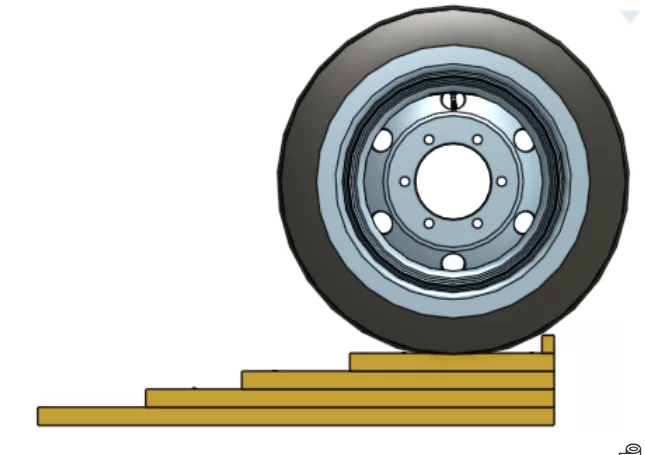
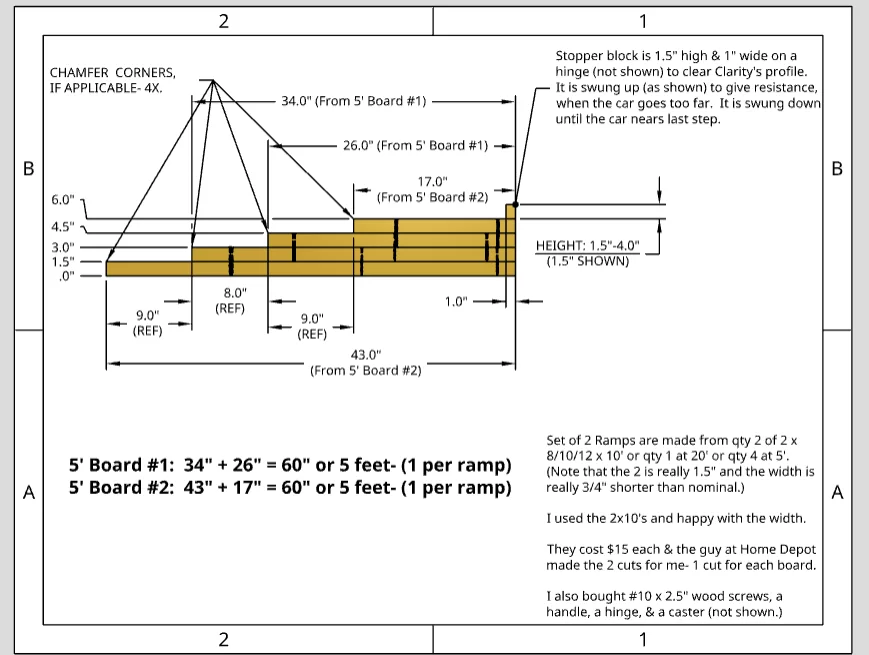
This simple version cost around $18-$40 (depending on going 7.25" wide versus 9.25" versus 11.25") for the wood, screws, and hinge for the stopper. I attached the CAD model, drawing; and I will add pictures with it under the Clarity shortly. It took me around an hour to build the 2 ramps, not counting watching youtube videos on the subject, buying materials, designing, etc. Some people add lightening holes, as they weigh over 18lbs for 7.25" wide version & 23lbs for 9.25" version & 28lbs for the 11.25" wide version; but I will add casters and a handle to easily wheel them around. I also plan (you might be better doing it before the assembly though) to chamfer the corners of the wooden boards so that the car can more smoothly climb the ramp; but it works well as shown in the drawing below without the chamfers.
I may increase the height of the stopper board on the far right of the drawing, but what is shown is the material that I had at home. I may go to 3 or 4 inches high on the hinged stopper. It has a hinge so that it is out of the way until the car is near the last step; when the stopper board will be "hinged" into place. The Clarity wont clear with the stopper board in place, until it climbs a couple of steps.
Double the materials shown in the drawing, if you want to build a set of ramps. So, for a set, you can buy qty 2 of 2 x 8/10/12 x 10' or qty 1 at 20' ( https://www.homedepot.com/p/2-in-x-...dard-Grade-Dimensional-Lumber-00155/310242077 for the 10 wide, https://www.homedepot.com/p/2-in-x-...dard-Grade-Dimensional-Lumber-00204/322889303 for the 8 wide or https://www.homedepot.com/p/2-in-x-...dard-Grade-Dimensional-Lumber-00171/310242081 for the 12 wide) or qty 4 at 5' (whichever is cheaper or easier for you.) If you ask and they are not busy, many lumber dealers will make the easy cuts needed for you at little or (often) no charge. Each of the 8" or 10" or 12" widths will work with the Clarity; but I prefer the 10" wide version. The tires do not over hang like the 8" version; and it is a good bit cheaper than the 12" wide version. (Once again, subtract .75" from these nominal widths to get the actual width of the boards. So, 8= 7.25", 10= 9.25" and 12= 11.25" wide.)
Attachments
Last edited:


 - see below. Yes, when you factor in time, etc; but it was fun to design, lay out in Cad, and build to me