How Aptera ranks among EV brands on social media

  • Thread starter Thread starter amosbatto
  • Start date Start date
  • Replies Replies 13
  • Views Views 89

amosbatto

New Member
After arguing with the people at r/ApteraMotors, I wrote this blog article:
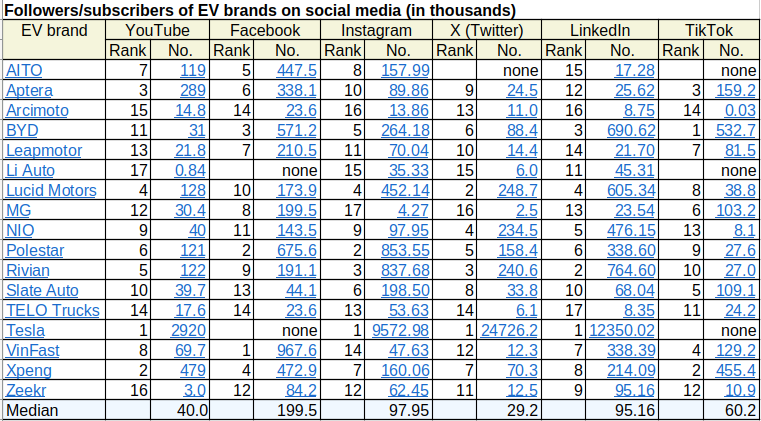

I would like to hear your thoughts on the article, and any feedback on the accuracy of the article.
 
After arguing with the people at r/ApteraMotors, I wrote this blog article:


I would like to hear your thoughts on the article, and any feedback on the accuracy of the article.
While I can't say that I found the topic interesting I will say that it appears to have been very well-researched. You do keep referring to Aptera as a "solar car" - which is both misleading and inappropriate: In standard English parlance, "car" and "automobile" are used interchangeably and Aptera is neither of those. Aptera is classified as an "autocycle" in most jurisdictions and as a "motorcycle" in the remainder. Aptera Motors refers to their vehicle as a "Solar Electric Vehicle".

The term, "solar car", is most commonly applied to vehicles that are charged entirely by and/or run directly from solar energy. As some of the comments you included show, there are those who don't understand that Aptera is an electric vehicle that can ALSO be charged from onboard solar panels. IMHO, Aptera needs to better clarify its message: Right now it's mainly "preaching to the choir"...

Those who go on about no one wanting an Aptera and the unsustainability of selling fewer than millions of vehicles per year need to be reminded that there are PLENTY of 2-seat, low-volume vehicles on the market. Chevrolet, for example, produces (and sells) just about 58,000 two-seat Corvettes each year, all coming from a single, dedicated factory. No one EVER complains that you can't fit a family of five in a Corvette or that it doesn't look like every other vehicle on the road...
 
While I can't say that I found the topic interesting I will say that it appears to have been very well-researched. You do keep referring to Aptera as a "solar car" - which is both misleading and inappropriate: In standard English parlance, "car" and "automobile" are used interchangeably and Aptera is neither of those. Aptera is classified as an "autocycle" in most jurisdictions and as a "motorcycle" in the remainder. Aptera Motors refers to their vehicle as a "Solar Electric Vehicle".

The term, "solar car", is most commonly applied to vehicles that are charged entirely by and/or run directly from solar energy. As some of the comments you included show, there are those who don't understand that Aptera is an electric vehicle that can ALSO be charged from onboard solar panels. IMHO, Aptera needs to better clarify its message: Right now it's mainly "preaching to the choir"...
To be fair to Aptera Motors, they call it a "solar electric vehicle" on their web site, so I'm the one who is guilty of calling it a "solar car". Most people don't know what an "autocycle" is, so it is a poor term from the point of view of marketing. A number of reviewers have commented that the Aptera drives and feels like a normal car (aside from the visibility issues), so I can see why many of the reviewers refer to it as a "car".

The bigger issue is whether there is enough demand for a two-seat vehicle, since the market for two-seaters is currently very limited. You might want to read my previous article where the issue of demand is discussed. See: Why the Aptera solar car represents a paradigm shift for the auto industry

Personally, I foresee the demand being much higher than the critics predict, but I also think that it will take a while for normal people to figure out the advantages of a 3-wheeled, two-seater solar vehicle, and I don't expect mainstream adoption until Aptera releases its next vehicle which is rumored to be a 4 wheel sedan, but that will be far in the future (assuming the company survives).
 
The bigger issue is whether there is enough demand for a two-seat vehicle, since the market for two-seaters is currently very limited.
FYI: Here's a list of the 2-seater automobiles currently available from legacy automakers in the US, listed by number of sales.
  • Nissan: Nissan Z
  • Toyota: GR Supra
  • Chevrolet: Corvette (Stingray, Z06, E-Ray, ZR1)
  • Porsche: 718 Cayman, 718 Boxster, and variants (Spyder RS)
  • BMW: Z4 Roadster
  • Aston Martin: Vantage and Vanquish
  • Lamborghini: Revuelto, Temerario
  • McLaren: Artura, 750S, W1
  • Lotus: Emira
  • Ferrari: 296
  • Maserati: MC20
  • Audi: R8
 
FYI: Here's a list of the 2-seater automobiles currently available from legacy automakers in the US, listed by number of sales.
  • Nissan: Nissan Z
  • Toyota: GR Supra
  • Chevrolet: Corvette (Stingray, Z06, E-Ray, ZR1)
  • Porsche: 718 Cayman, 718 Boxster, and variants (Spyder RS)
  • BMW: Z4 Roadster
  • Aston Martin: Vantage and Vanquish
  • Lamborghini: Revuelto, Temerario
  • McLaren: Artura, 750S, W1
  • Lotus: Emira
  • Ferrari: 296
  • Maserati: MC20
  • Audi: R8
I'm glad that back in 1999, when Honda still had guts, they made me a 2-seat, all-aluminum, Honda Insight gas-electric hybrid on the same production line that made the 2-seat NSX and the 2-seat S2000. I liked my 2000 Insight so much that, in 2006, I bought the last one I could order and drove it until 2019, when repair parts started to become scarce.

Being a very lightweight, super-efficient vehicle, The Aptera is the closest concept to Honda's original Insight. Sadly, with each succeeding generation, Honda kept making the Insight bigger and heavier and now the name has been attached to an electric crossover built in China. Honda will probably never make another 2-seat automobile.
 
I'm glad that back in 1999, when Honda still had guts, they made me a 2-seat, all-aluminum, Honda Insight gas-electric hybrid on the same production line that made the 2-seat NSX and the 2-seat S2000. I liked my 2000 Insight so much that, in 2006, I bought the last one I could order and drove it until 2019, when repair parts started to become scarce.

Being a very lightweight, super-efficient vehicle, The Aptera is the closest concept to Honda's original Insight. Sadly, with each succeeding generation, Honda kept making the Insight bigger and heavier and now the name has been attached to an electric crossover built in China. Honda will probably never make another 2-seat automobile.
And the Civic is now nearly the size of "my father's Oldsmobile"!
 
FYI: Here's a list of the 2-seater automobiles currently available from legacy automakers in the US, listed by number of sales.
  • Nissan: Nissan Z
  • Toyota: GR Supra
  • Chevrolet: Corvette (Stingray, Z06, E-Ray, ZR1)
  • Porsche: 718 Cayman, 718 Boxster, and variants (Spyder RS)
  • BMW: Z4 Roadster
  • Aston Martin: Vantage and Vanquish
  • Lamborghini: Revuelto, Temerario
  • McLaren: Artura, 750S, W1
  • Lotus: Emira
  • Ferrari: 296
  • Maserati: MC20
  • Audi: R8
I found this list of top sports car sales from Q1 2026:
1. Ford Mustang: 14,074
2. Chevrolet Corvette: 6,235
3. Porsche 911: 3,826
4. Toyota GR86: 2,046
5. Mazda Miata: 1,695
6. Toyota GR Supra: 919
7. Nissan Z: 899
8. Subaru BRZ: 803
9. BMW Z4: 478
10.Porsche 718: 206
Top 10 Total: 31,181

Based on that, it appears that the two-seater market is only 1% of the total auto market in the U.S., which was 3,685,799 autos in Q1 2026.
 
I found this list of top sports car sales from Q1 2026:
1. Ford Mustang: 14,074
2. Chevrolet Corvette: 6,235
3. Porsche 911: 3,826
4. Toyota GR86: 2,046
5. Mazda Miata: 1,695
6. Toyota GR Supra: 919
7. Nissan Z: 899
8. Subaru BRZ: 803
9. BMW Z4: 478
10.Porsche 718: 206
Top 10 Total: 31,181

Based on that, it appears that the two-seater market is only 1% of the total auto market in the U.S., which was 3,685,799 autos in Q1 2026.
The Ford Mustang and the Toyota GR86 aren't 2-seaters.
 
The Ford Mustang and the Toyota GR86 aren't 2-seaters.
Yes, although the rear seating space is very limited in both of those models. They can work for kids, but it would be a pain to get a kid into a child seat. Still, it does prove that the two seater market is very small. It will be interesting to see whether Aptera can prove that more people will buy two seater cars. 64% of American households have 2 or fewer occupants, but two seaters are less than 1% of the American auto market.
 
After arguing with the people at r/ApteraMotors, I wrote this blog article:


I would like to hear your thoughts on the article, and any feedback on the accuracy of the article.
Quite the long article/analysis. Amazing how much time people have to analyze.
Disclosure: I am an Aptera investor and have two reserved to buy.
Simple story: Aptera is a true innovation laying claim to the most efficient production EV designed and nearing production. That efficiency is what drew me, the solar charging is secondary. The innovation, the straightforward and transparent social media posts about the development and the financing of the company, these make for plenty of interest and social media subscribers.
 
Aptera is a true innovation laying claim to the most efficient production EV designed and nearing production.
Honda just announced a new platform with a next-generation (2028) hybrid setup that Honda claims will be the “world’s most efficient powertrain.” I hope Aptera will soon be asking Honda, "hold my beer."
 
Honda just announced a new platform with a next-generation (2028) hybrid setup that Honda claims will be the “world’s most efficient powertrain.” I hope Aptera will soon be asking Honda, "hold my beer."
This is mostly marketing baloney for why Honda decided to scrap its BEV models and stick with hybrids. From what I have read, Toyota's hybrid system (Atkison-cycle motor and two electric motors/generators) is a bit more energy efficient than Honda's hybrid system (Atkison-cycle generator, Otto-cycle motor for high power and an electric motor), but Honda's second ICE motor provides a bit more power and a better driving experience. Toyota and Honda are considered to have the two best hybrid systems in the auto industry, so it is understandable why the two companies have decided to focus on hybrid tech, rather than embrace BEVs.

However, both of these Japanese companies are fundamentally misreading where the market is going. Hybrids only make sense when batteries are expensive and charging is slow. What these companies don't realize is how fast LMFP and sodium ion battery chemistries are advancing and how they will eliminate the demand for hybrids. LFP and LMFP are driving down the price of batteries, and sodium ion is going to make batteries dirt cheap. With BYD and Geely both rolling out 1500 kW charging, charging is going to become very fast in the future.

There are questions at this point about how energy dense sodium ion will become and how fast BYD and Geely can build out their high-speed charging networks, but the Japanese auto companies are essentially cutting their own throats by refusing to embrace BEVs. Once BYD and Geely build their high speed charging networks in China and Europe, they are going to turn to the developing world, and that is going to destroy Toyota's and Honda's global market. The only hope for the long-term survival of Toyota and Honda is if Japan and the U.S. can keep out the Chinese automakers, but the Japanese automakers are essentially ceding the rest of the world to the Chinese automakers. It will take a while to build out the charging infrastructure in places like Africa and Latin America, so Toyota and Honda aren't going to lose their markets nearly as fast as the European legacy automakers, but it is still going to be a blood bath.
 
Last edited:
but the Japanese auto companies are essentially cutting their own throats by refusing to embrace BEVs
If the U.S. wasn't cutting its own throat by disfavoring BEVs, I'm sure every Japanese company would be racing to supply them. Especially while the U.S. continues to block the sale of most vehicles from China.
 
Back
Top