It's quite a dissertation! It's well-structured, well-written and, overall, it supports its thesis - but my cursory reading revealed a number of points that an editor would question. Here's a sampling: 1) "solar vehicle" as opposed to "solar charging vehicle" - the terms are not interchangeable., 2) Aptera is testing several solutions to dashboard glare and footwell width - is it accurate to describe these issues as if they are part of a production vehicle?, 3) Aptera has not released the vehicle's coefficient of drag figures., 4) Aptera's doors do not open more than an inch or two wider than the width of the vehicle, whereas standard vehicle door open to nearly double the width of the vehicle., 5) Aptera's document holder is a zippered pouch, not a net., 6) What "creature comforts" does Aptera lack?, 7) Aptera has a standard wire harness - what it has replaced is a centralized electrical control system with a semi-decentralized one., 8) Although Epic boats are currently made from CF materials, during Anthony's tenure they were made from a GF/foam sandwich - which was to have been the material of choice for the Aptera., 9) Chevrolet produced the "Stingray" trim of its Corvette from 1963-1976., 10) The Mazda MX-5 is not an "expensive sports car", expecially when compared to current 2-seater offerings from Nissan, Toyota, Porsche, Audi, BMW, Mercedes, Jaguar, etc.
Were I to do a closer reading of the text I'd most likely bring more points to your attention. IMHO it's always wise to eliminate as many opportunities for criticism as possible!
Thanks for the detailed feedback. I have changed some things, and you gave me something to think about for the others.
Here are the parts that I changed in the article:
From:
The Aptera engineers
replaced the conventional wire harness with direct wiring to each control that would have weighed roughly 90 lbs with a zonal architecture that is more modular and weighs just 30 lbs.
To:
Instead of using a conventional electrical system with direct wires from a central controller to each control, the Aptera uses
a zonal architecture, which is more modular and reduces the weight of the wiring from 90 to 30 lbs.
I changed Fambro's description from "experience creating carbon composite wake boats" to "experience creating composite wake boats".
I rewrote this part to be:
The Launch Edition, however, sacrifices visibility through the rear hatch and
adds extra glare to the dashboard in order gain more solar capacity. Aptera has addressed the lack of a rear window by
adding a rear-view camera, mounted in the brake lamp at the top of the rear hatch, which is displayed in the center mirror, and another backup camera, located beneath the license plate, that is displayed on the center screen when reversing. Aptera also added a
matte, anti-reflective coating to the dashboard solar cells to counteract the glare.
I'm not going to change the foot well part until Aptera actually makes changes. Recent reviews say that there is still dashboard glare, but I'm not sure if they have the anti-reflective coating or not.
Thanks for catching the bag part. I changed it to this:
There is a zipped bag to hold papers in place of a glove box.
There is a modern
Corvette Stingray, but there aren't many on the road, and I didn't realize how cheap the Miata is (starts at $30k) and it seems to be the most popular two seater in the US, so I changed "expensive sports cars" to just "sports cars" and replaced the Stingray with the Porsche 718.
I change it to:
Almost all the two-seater cars on the market today are either sports cars, like the
Mazda MX-5 Miata and
Porsche 718, or hobbled city cars ...
I changed this part to:
The Aptera is anticipated to have a
drag coefficient (Cd) of 0.13, which will be the lowest Cd of any production passenger car.
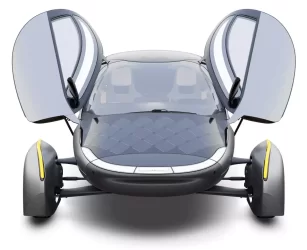
Regarding the width of the open butterfly doors, It looks like it is more than a couple inches wider than the wheel pants to me in photos, but I haven't seen the Aptera in person. It would be cool if someone could measure that for me.

 amosbbatto.wordpress.com