
You are using an out of date browser. It may not display this or other websites correctly.
You should upgrade or use an alternative browser.
You should upgrade or use an alternative browser.
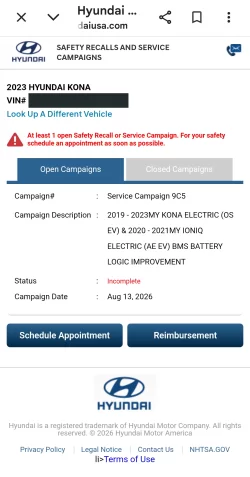
Service Campaign 9C5, BMS Battery Logic Improvement, issued August 13 '26
- Thread starter mtd
- Start date
- Replies 2
- Views 41


KiwiME
Well-Known Member
Probably the same as was discussed many months ago, finally bubbling to the surface in NA.
I heard wind of another BMS recall and sure enough, after checking my Vin# with Hyundai, they want to run some diagnostics on it. 2019 Kona EV
Checking for battery cell damage and updating BMS software I think. Sounds like the current BMS S/W may lead to over heating/charging and cause a fire in super rare cases.
Checking for battery cell damage and updating BMS software I think. Sounds like the current BMS S/W may lead to over heating/charging and cause a fire in super rare cases.
- Electric Rich
- Replies: 30
- Forum: Kona Electric

I was curious what exactly was changed with the BMS software in this recall, and this is what AI came up with:
Service Campaign 9C5 is specifically a diagnostic improvement to the high-voltage Battery Management System (BMS), rather than a general battery-performance update. The interesting detail is that Hyundai identifies the new software as implementing something called DDQT logic.
I found the actual Hyundai Technical Service Bulletin, 26-01-065H, issued August 2026, which applies to your 2019 Hyundai Kona Electric, along with other 2019–2023 Kona Electric and 2020–2021 Ioniq Electric vehicles.
The important distinction is that Hyundai's publicly released documentation describes what category of functionality changes, but doesn't fully explain the underlying diagnostic algorithm.

OEMDTC
The designation DDQT is the strongest clue about what has changed. However, the bulletin doesn't define the acronym or publish the detection thresholds, mathematical algorithms, or fault criteria.
That means it would be misleading to claim Hyundai has definitely changed a particular cell-voltage threshold, temperature threshold, or charging restriction without additional engineering documentation.
OEMDTC
Hyundai Motor Company and Kia have a patent, US12613287B2, titled Apparatus for Diagnosing Abnormality of Battery Cell and Method Thereof, which explicitly describes a diagnostic calculation named DDQT. The patent was granted April 28, 2026.
Source: Hyundai/Kia patent US12613287B2

Google Patents
This is a compelling technical match for the campaign, although I cannot confirm that Campaign 9C5 implements this exact patented algorithm.
In simplified terms:

Where \(a_i\) is the individual cell's ICA value and \(A\) is the average ICA value for that voltage region.
For example, a cell with a DDQT of 90% differs from the average by 10%. The patent discusses comparing these deviations to diagnostic criteria to identify abnormalities.
Google Patents

NHTSA
The potential significance of DDQT is that it could detect subtle changes in cell electrochemical behavior before a conventional voltage-based fault becomes apparent.
That would be particularly relevant to identifying developing internal cell defects and reducing the risk of thermal runaway.
The especially interesting finding is that the DDQT terminology appears both in the 2026 campaign and in Hyundai's battery-cell diagnostic patent. That gives us a plausible explanation of how the diagnostic improvement works, beyond Hyundai's generic description.
The missing piece is an explicit technical link between the patent and the actual firmware.
Service Campaign 9C5 is specifically a diagnostic improvement to the high-voltage Battery Management System (BMS), rather than a general battery-performance update. The interesting detail is that Hyundai identifies the new software as implementing something called DDQT logic.
I found the actual Hyundai Technical Service Bulletin, 26-01-065H, issued August 2026, which applies to your 2019 Hyundai Kona Electric, along with other 2019–2023 Kona Electric and 2020–2021 Ioniq Electric vehicles.
The important distinction is that Hyundai's publicly released documentation describes what category of functionality changes, but doesn't fully explain the underlying diagnostic algorithm.
OEMDTC
What Hyundai actually changed
The bulletin specifies:| Item | Details |
|---|---|
| Campaign | 9C5 |
| TSB | 26-01-065H |
| System updated | High-voltage Battery Management System |
| Hyundai update description | OS EV BMS Battery Logic Improvement (Applied DDQT Logic) |
| GDS update event | 1370 for Kona Electric |
| New BMS ROM IDs | 7220 / 7222 / 7420 / 7422, depending on ECU version |
| Stated purpose | Improve the BMS diagnostic capability |
That means it would be misleading to claim Hyundai has definitely changed a particular cell-voltage threshold, temperature threshold, or charging restriction without additional engineering documentation.
OEMDTC
The key discovery: Hyundai has a patent describing DDQT
I found something substantially more informative than the TSB.Hyundai Motor Company and Kia have a patent, US12613287B2, titled Apparatus for Diagnosing Abnormality of Battery Cell and Method Thereof, which explicitly describes a diagnostic calculation named DDQT. The patent was granted April 28, 2026.
Source: Hyundai/Kia patent US12613287B2
Google Patents
This is a compelling technical match for the campaign, although I cannot confirm that Campaign 9C5 implements this exact patented algorithm.
How the patented DDQT diagnostic works
The patent describes using Incremental Capacity Analysis (ICA) to identify abnormal battery cells during charging.In simplified terms:
- Measure charging behavior. The BMS observes how much charge individual cells accept as their voltages change.
- Divide charging into voltage regions. Rather than looking only at total cell voltage, it examines specific portions of the charging curve.
- Compare cells against their peers. It calculates an ICA value for each cell and compares it with the average across the battery.
- Identify unusual cells. A cell whose charging characteristics differ significantly from the others can be flagged as potentially abnormal.
Where \(a_i\) is the individual cell's ICA value and \(A\) is the average ICA value for that voltage region.
For example, a cell with a DDQT of 90% differs from the average by 10%. The patent discusses comparing these deviations to diagnostic criteria to identify abnormalities.
Google Patents
Why this matters for your Kona
The older Kona BMS updates already included enhanced battery diagnostics. For example, Service Campaign 9A4 (2023) addressed fault codes P1AA6–P1AAF, with some conditions requiring complete battery replacement.NHTSA
The potential significance of DDQT is that it could detect subtle changes in cell electrochemical behavior before a conventional voltage-based fault becomes apparent.
That would be particularly relevant to identifying developing internal cell defects and reducing the risk of thermal runaway.
What this update probably does not change
There is no published evidence in TSB 26-01-065H that Campaign 9C5 intentionally changes:- Maximum charging speed or charging current.
- Usable battery capacity or driving range.
- The upper charging limit or battery buffer.
- Normal battery cooling behavior.
- Cell balancing algorithms.
My conclusion
The evidence points toward earlier and more sophisticated detection of high-voltage battery cell abnormalities, not improved battery efficiency or performance.The especially interesting finding is that the DDQT terminology appears both in the 2026 campaign and in Hyundai's battery-cell diagnostic patent. That gives us a plausible explanation of how the diagnostic improvement works, beyond Hyundai's generic description.
The missing piece is an explicit technical link between the patent and the actual firmware.